
+Free Morning Routine Kit (printable tools & planner)
The Tony Robbins priming morning routine combines breathwork, gratitude, and visualization to shift your state quickly. This article breaks down the exact steps, what science says, and how to try a realistic version in your own mornings.
By GoToBetter | Tested by real life, not just theory
What Is the Tony Robbins Priming Morning Routine?
The Tony Robbins priming morning routine is designed to change your emotional state in about ten minutes. It combines three elements: powerful breathing, gratitude reflection, and visualization of future goals. Robbins frames it as a way to “prime” your mind and body before the day begins.
Here’s the thing: you don’t need to copy it exactly. The shouting, pumping arms, or hyped-up intensity aren’t required. What matters is using small, deliberate cues — breath, thought, and focus — to shift your state before the day pulls you in.
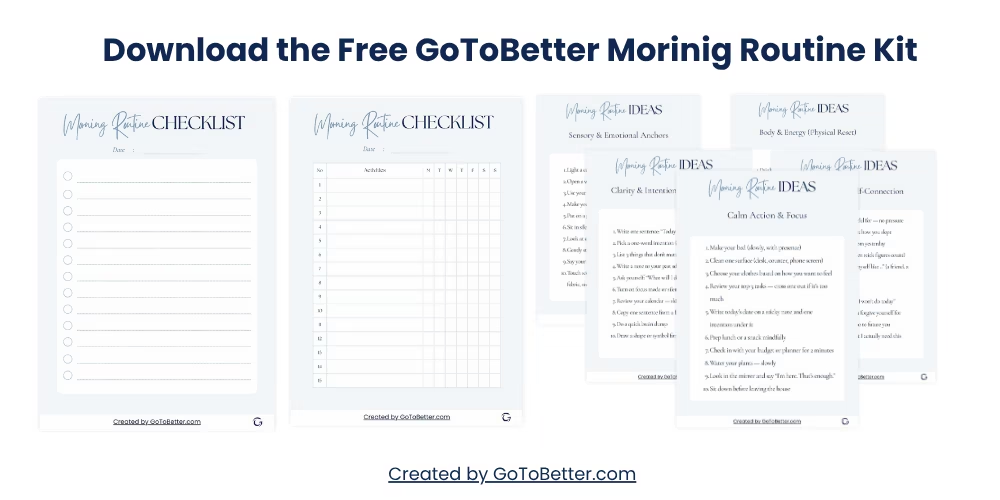
And if you want support while shaping your own mornings, start with the Free Morning Routine Kit. It gives you:
- 50 Morning Routine Ideas — flexible actions for every kind of morning
- Daily Morning Routine Template — a clean space to map or track your routine
- Weekly Morning Planner — a layout to test versions and see what works
Use it to circle, sketch, or experiment. It’s practical and real — not theory.
Write your email and get your Free Kit here↓
Why It’s Called “Priming”: The Psychology Behind It
Priming is a psychology term for how small cues influence perception and action before you notice it. In a morning context, a single breath can become a state cue that tilts attention toward calm and readiness. That’s the practical core beneath the stage lights.
In the Tony Robbins framework, breathwork, gratitude reflection, and goal imagery are combined as priming exercises to shift your “baseline” quickly. When breath slows or energizes the body, attention follows; when attention lands on what’s steady or meaningful, emotion stabilizes; when imagery sketches a near-future action, behavior has a runway. Together, these simple components act like adjusting the dimmer, not flipping a switch.
Psychologists have explored related mechanisms for decades: John Bargh on automaticity and cueing, Daniel Kahneman on attention and fast/slow processing, and research by Robert Emmons and Michael McCullough on gratitude as a mood regulator. Sports psychology adds a long history of rehearsal imagery — a visualization method to pre-load motor and focus circuits. The Robbins packaging is loud; the underlying ideas are not new.
If you prefer a quieter approach, the same logic holds. A few energizing breaths function like tapping the thermostat. Gratitude narrows noise and strengthens an attentional filter. A tiny plan sketched in your head becomes a breadcrumb for the next hour. Think of it like tuning a radio until the station is clear enough to recognize the song.
GoToBetter says it like this: “Priming is not motivation; it’s orientation — a quick nudge that makes the next right action easier to see.”
None of this requires shouting. Breath, a single memory of something steady, and one image of a near action are enough to move the needle. That’s the psychology Robbins calls “state change,” minus the stadium volume.
Does It Work? Science vs Hype
Short answer: parts of it do, especially in small doses and with consistent repetition. The Tony Robbins priming morning routine stitches together known levers — arousal regulation, attention framing, and rehearsal imagery — into one sequence. Where evidence is thinner is in the promise of a guaranteed “peak state practice” that transforms every day. What’s measurable tends to be mood and focus shifts, not magic.
Gratitude research shows modest, reliable benefits for mood stability and resilience. Imagery helps when it’s process-focused (seeing the steps) rather than outcome-only (seeing the trophy). Breathing works because physiology is upstream: change breath, and heart rate variability follows. The evidence-light zones are sweeping claims and one-size-fits-all prescriptions; the strongest zone is steady, repeatable practice that creates small wins.
Where does hype creep in? When the method is presented as universal, or when intensity is treated as the only path. Some people benefit from a brisk, energizing start; others perform better after quiet settling. The point is alignment, not theater. If a calmer routine helps, that’s still priming. If a louder one genuinely fits your temperament and context, do it safely — and skip any elements that feel like pressure rather than preparation.
GoToBetter InsightUse a 5-minute cap instead of open-ended routines. Constraints turn priming exercises into a daily ritual for focus and prevent drift into procrastination disguised as preparation.
To stay honest, treat results like an experiment. Notice mood, attention, and task initiation over two weeks. Keep a single line of notes: “energy/focus start” and “first task started.” If your energy boosting routine delivers earlier starts or fewer false begins, keep it. If it doesn’t, revise without loyalty to the brand. That’s how personal development habits stay practical rather than performative.
Benefits People Notice: Energy, Focus, Gratitude
People who keep at a morning mindset routine report similar themes: a steadier start, fewer reactive spirals, and a clearer “first move.” After three to five days, it often feels like less friction getting from kitchen to keyboard. That’s not a miracle; it’s cumulative orientation. A small ritual reduces decision load, and the day opens with fewer mental tabs.
Breathwork can deliver quick “calm activation” — not sedated, just steady. Gratitude visualization shifts attention away from scanning for problems and toward scanning for anchors. Imagery of a near-term action (send the email draft, step outside for light) shrinks hesitation. Individually these are modest gains. Together they become clearer focus in the first hour, which often sets the tone for the next three.
You might notice this pattern: one slow inhale on the doorstep before a commute, one gratitude about yesterday’s small win while coffee brews, and one picture of opening the calendar to a single block. No fanfare, no performance. Just nudges that tilt posture and attention. Over time, this repeats like lines on a road: ordinary, helpful, easy to follow.
| Habit | Track It? | Why |
|---|---|---|
| Breathwork burst (30 fast or 3 slow cycles) | Lightly | Notice “settled/ready” in one word; physiology is upstream of attention. |
| Gratitude reflection (20–40 seconds) | Optional | Anchors attention; research links gratitude with mood stability and resilience. |
| Goal imagery (one near action) | Yes | Process-focused visualization method reduces friction to start the first task. |
Call it an energy boosting routine if you like; the label matters less than the net effect: earlier initiation, fewer detours. Most people overestimate intensity and underestimate consistency. Keep the tool small and portable so it follows you into ordinary days, not just ideal ones.
Limits and Downsides: Real Talk
The loudest criticism is also the simplest: the show can overshadow the substance. For many people, the stage-style arm pumping introduces performative intensity that isn’t necessary for focus and can feel off-putting in real households. Loud affirmations may energize some, but they’re not a requirement for effective priming.
Another limit is the assumption of universality. If mornings include kids, a partner, roommates, or a commute, the noise floor is different. A quiet, two-minute sequence you can do while making coffee is more sustainable than a stadium routine. And a final boundary that matters: this is a preparation ritual, not therapy. It won’t resolve deeper patterns or replace professional help if that’s what’s needed.
Questions that help keep things honest tend to be simple: Does this reduce my hesitation in the first hour? Does it change how I approach the first meaningful task? Where in my actual morning could I do this without noise or friction? If the answers drift toward “not really,” adjust the parts — not your self-worth.
GoToBetter says it like this: “Priming helps when it’s quiet enough to notice it; volume adds spectacle, not skill.”
Remember the original claim: faster access to a workable state. The tony robbins morning routine brand may sell intensity; your life probably needs repeatability. Keep the pieces that lower friction. Drop any that feel like a performance review at 7 a.m.
How to Try It in Real Mornings (A Calm, Portable Version)
Here’s a small, usable format that respects the psychology and skips the theater. It keeps the sequence short on purpose so it fits cramped schedules and shifting moods. If it feels like an on-ramp rather than a ceremony, it will survive Tuesdays, not just Sundays.
GoToBetter InsightStart with three breaths, one gratitude, one micro-visualization. Then anchor a physical cue. The sequence minimizes cognitive load and builds a stable morning mindset routine.
How to Try the Tony Robbins Priming Routine in 5 Minutes
This is a condensed, practical version of the Tony Robbins priming morning routine designed for ordinary homes and schedules. Follow the repeatable steps and keep the whole block to five minutes or less.
Step 1 – Breathe to Set the Meter
Use the tony robbins breathing technique vibe without theatrics: either 30 quick power breaths through the nose or three slow 4–6 second breaths. Choose energizing or calming based on the day. Let breath set the tempo before thought.
Step 2 – Name One Gratitude Anchor
Pick one specific detail from the last 24 hours: a kind message, warm light on the table, a solved glitch. Hold it for 20–40 seconds. This is gratitude visualization in miniature — enough to tilt attention.
Step 3 – Visualize a Near Action
See the first useful move you can start within 10 minutes: open the draft, lace shoes, step into daylight. Keep imagery process-focused. This visualization method reduces ambiguity and pre-loads initiation.
Step 4 – Add a Physical Anchor
Pair a simple cue with the end of the sequence: press thumb to forefinger, exhale and nod, or touch the notebook. The anchor links to state change psychology so the cue recalls the sequence later.
Step 5 – Close with a Sentence
Say a quiet, specific line: “First block: 25 minutes on the draft.” Keep it short. This becomes your daily ritual for focus and transitions you from preparation to action.
Keep the structure short on purpose. If life is loud, whisper the steps in your head and do them while the kettle heats. If life is quiet, sit for the same sequence with a timer. The win is a set of repeatable steps that travel well. The Tony Robbins priming morning routine can be this modest and still effective.
Two small tracking ideas if you enjoy data: mark a single dot on a calendar when you complete the sequence, and jot a two-word “start state” in a margin (“foggy → steady”). If the dots and words trend better over a couple of weeks, keep going. If not, iterate without guilt.
GoToBetter Mini Tool: 3–1–1 Priming Check (60 Seconds)
Use this one-minute prompt to choose your mode and set a tiny runway for action.
- Circle a mode: Calm or Energize. Say it quietly.
- Write five words for one gratitude anchor from the last 24 hours.
- Write one near action you can start in 10 minutes or less.
- Do three breaths to match your mode (slow for Calm, brisk for Energize).
- Touch thumb to forefinger to lock the cue. Score friction 0–2. If it’s 2, shrink the action.
Want to Keep Going? Here’s What Helps Next
This article is part of the GoToBetter Morning Routine series — practical tools for steady starts, not performance theater.
If you want the bigger picture on building a morning that actually fits your life, start here:
Read The Ultimate Guide to Morning Routines — a no-fluff map for designing calm, repeatable mornings without apps or pressure.
And if you want something you can use tomorrow, grab the Free Morning Routine Kit. It includes exactly what you need to experiment without overthinking:
- 50 Morning Routine Ideas — a categorized list of flexible actions
- Daily Morning Routine Template — a clean space to map or track each day
- Weekly Morning Planner — a simple layout to test versions and see what works
Type your email and download the Morning Routine Kit now — keep it within reach for your next start.
Tony Robbins Priming Morning Routine FAQ
Is Tony Robbins priming backed by science?
Parts of the sequence align with evidence on breathwork, gratitude, and visualization. Priming exercises leverage state change psychology to nudge attention and readiness, but the full branded routine itself hasn’t been tested as a single protocol. Expect modest improvements in mood, focus, and task initiation, especially with consistent practice.
Can I do priming without shouting or arm-pumping?
Yes—quiet versions work as well or better for most homes. Combine three calm or brisk breaths, a specific gratitude visualization, and a process-focused image of your first task. If intensity adds pressure, drop it and keep the portable daily ritual for focus.
How long should a priming routine take in real life?
Two to five minutes is plenty for daily use. A short sequence is easier to repeat than a peak state practice that demands time and privacy. Try the 3–1–1 format: three breaths, one gratitude anchor, one near action you can start within ten minutes.
What’s the difference between priming and meditation?
Priming is a brief, goal-oriented sequence that shifts state using cues and imagery; meditation trains attention and awareness over longer windows. They can complement each other: a 3-minute priming start before a 10-minute sit, or the reverse if you need more calm than drive.
Can I use the priming sequence at night?
Yes, but adjust it toward downshifting. Swap to slow breathing, recall one steadying detail from the day, and visualize a shutdown step like dimming lights or staging clothes for morning. Keep energizing elements for the morning mindset routine where activation is the goal.
Ready to Go Deeper?
When a simple morning sequence starts to feel grounding, it can help to see the bigger pattern. That’s where a clear tracker earns its keep.
The Ultimate Habit Tracker (Google Sheets) simplifies routine building with customizable daily, weekly, and monthly views. Track habits, visualize progress automatically, and stay consistent without complicated setups.
- Save time with automated updates and clean, dynamic visuals.
- Access anywhere — laptop, phone, or offline — your data stays in your Google account.
- Reflect weekly to spot patterns, celebrate wins, and adjust with less effort.
- Tailor categories and goals to fit your life, not someone else’s plan.
If wellness is your main focus, explore the Wellness Tracker for mood, sleep, and daily wellness habits — or build gentle consistency with the Self-Care Tracker for up to 30 self-care activities with automated check-ins and clear summaries.
Want to browse everything in one place? Visit the GoToBetter Shop — systems built for real life, from quick daily check-ins to full reflection frameworks.