
+Free Morning Routine Kit (printable tools included)
The 20/20/20 morning routine divides your first hour into movement, reflection, and learning — but this guide shows how to adapt it with flexible 10/10/10 versions, real-life examples, and printable tools that keep it simple. Includes: clear breakdowns, myths debunked, and flexible templates.
By GoToBetter | Tested by real life, not just theory
What Is the 20/20/20 Morning Routine?
The 20/20/20 morning routine is a structure made popular by Robin Sharma in The 5AM Club. It breaks your first hour into three 20-minute blocks: movement, reflection, and learning. The idea is simple — move your body, check in with your mind, then feed it something new before the day starts.
But let’s be clear: **you don’t need to wake up at 5AM** or follow the blocks with military precision. What matters is balance — some time for your body, some for your thoughts, and some for growth. Even shorter versions can work.
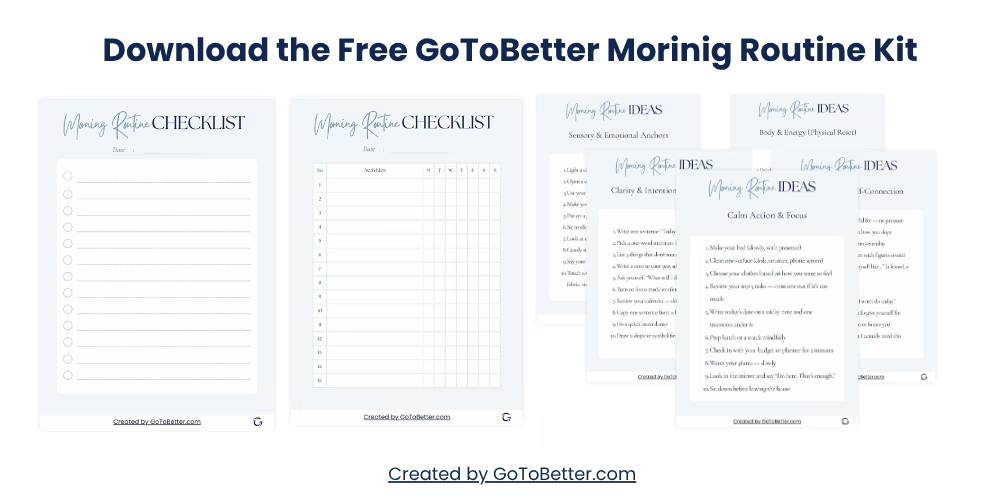
And if you want help making it real, start with the Free Morning Routine Kit. It’s built for experimenting, not perfection. Inside you’ll find:
- 50 Morning Routine Ideas — practical actions for different mornings
- Daily Morning Routine Template — print, sketch, or track your version day by day
- Weekly Morning Planner — test 20/20/20, 10/10/10, or any rhythm that fits
Use it to circle, sketch, or scribble. The point isn’t a flawless plan — it’s something you can actually use in real life.
Write your email and get your Free Kit here↓
Where It Came From (And What People Miss)
The idea shows up in Robin Sharma’s The 5AM Club, but the value isn’t the hour — it’s the structure.
Think of it as a tripod: movement, reflection, learning. Kick out one leg and the rest wobbles. Keep all three and the morning stands on its own.
Most write-ups repeat the story and the rules. What they skip is the part where normal people need a flexible morning routine that survives alarms, kids, travel, and low-energy days.
Here’s the part that matters: **balance over precision**. Twenty minutes is a starting number, not a sacred ritual.
You’ll see the same pattern in other frameworks — Hal Elrod’s “Miracle Morning,” James Clear’s habit models, even Andrew Huberman’s notes on movement and light in the morning. They point in one direction: small, consistent inputs stabilize the day.
When you search for the 20 20 20 morning routine, you’ll get heroic stories and perfect schedules. Useful for inspiration. Less useful at 6:42 a.m. when the dog needs to go out and your coffee machine blinks “clean me.”
This article stays practical: keep the morning routine structure, but adjust the timing. Keep the three blocks, but swap methods based on your real life. That’s how to adapt 20/20/20 to your life without guilt.
GoToBetter says it like this: “The best morning routines are frameworks, not cages.”
You might notice a quiet shift when you treat the blocks as dials, not switches. One morning the dials sit at 10/15/20. Another, 5/10/10. The result: a day that starts grounded instead of rushed.
That’s the core: keep the simple morning rituals, keep the three-part flow, and stop confusing “perfect” with “useful.”
The Three Blocks, Clearly Explained
Underneath the branding, the 20/20/20 morning routine is just three clear blocks. Think: move, reflect, learn — an exercise–reflect–learn routine.
Movement
Get your heart rate up a little. Walk, jog, yoga, mobility, a short bodyweight circuit. The point isn’t to crush a workout; it’s to switch on your system. Andrew Huberman often underscores morning light and movement for alertness — same idea, different lens.
Reflection
Journal three lines. Breathe for five. Pray. Sit in silence. Ask: “What would make today feel well-spent?” Not a therapy session — a quick alignment check.
Learning
Read five pages. Listen to an audiobook. Watch a short lecture. Skim notes from a course. Feed your brain something clean before the day’s noise.
Keep examples friction-free: shoes by the door, notebook open on the table, book queued on your phone. You’re designing a runway, not a maze.
GoToBetter InsightStart with one minute in each block. Then extend by two minutes per week. The curve feels slow but compounds into a stable habit without rebound.
If you want an “audit” in one glance, ask three questions while making coffee: “Did I move at all? Did I check in with myself? Did I learn one thing?” If the answer is yes to two, the morning already did its job.
| Habit | Track It? | Why |
|---|---|---|
| 5-minute stretch flow | No | Faster than a workout; lowers friction so it actually happens. |
| One-line journal | No | Captures reflection without turning into a task. |
| 3 pages of a book | No | Small input, steady gain; sustains the learning block. |
Notice there’s no perfection test. The benefits of the 20/20/20 method show up when it’s doable, not when it’s ornate.
Do You Really Need a Full Hour?
Short answer: no. Long answer: it depends on your season, energy, and responsibilities.
You can keep the architecture of a flexible morning routine and size it down like a dimmer switch. Ten minutes total can still change the tone of your day.
What matters is starting. That’s how to start the 20/20/20 rule without waiting for a “perfect” Monday. Shrink the units. Keep the order. Let consistency prove the value.
Here’s the mental shift: **consistency beats heroics**. A tidy 9-minute version every weekday outperforms an aspirational 60 minutes done twice a month.
Personally, on heavy weeks I keep a “floor routine”: 90 seconds of mobility, one sentence in my notes app, one page of reading. It feels like cheating — in a good way. The day still steadies.
If you’ve read the Robin Sharma 5AM Club story and thought, “That’s not my life,” good news: this model survives late nights, early school runs, and changing shifts. It’s not about 5:00 a.m.; it’s about giving your morning a spine.
GoToBetter says it like this: “A morning ritual works when it bends, not when it breaks.”
Try a “week of floors.” Hold a tiny baseline for five days. If it feels light, add a minute per block next week. That’s how flexible productivity habits grow — quietly, without drama.
Flexible Versions That Actually Work (10/10/10, 15/15/15)
The 10/10/10 morning routine is the simplest on-ramp: ten minutes to move, ten to reflect, ten to learn. Same shape, less time. For some, 15/15/15 is the sweet spot — long enough to feel substantial, short enough to finish.
Choose Your Dial
Pick the smallest version that feels honest. That might be 3/3/3 on hard days and 15/15/15 when energy is high. Keep the order so your brain learns the cadence.
Sample Menus
Movement: walk around the block, five sun salutations, 20 squats. Reflection: one prompt (What would make today enough?), ten silent breaths, short prayer. Learning: two pages of non-fiction, a five-minute summary video, a saved newsletter.
The trick is to **fit your life**. If mornings are crowded, shift the learning block to lunch. If movement needs to be a commute, park farther and walk five minutes briskly. You’re adapting the 20/20/20 morning routine without losing its core.
GoToBetter InsightUse “anchor + micro” for each block. Anchor = the non-negotiable start cue; micro = the smallest action. The pair removes decision-fatigue and preserves momentum.
Real mornings look messy. One reader told me they did 10 minutes of stroller walking, wrote a single sticky note intention, and listened to three minutes of an audiobook while making oatmeal. The day still felt different — steadier, less reactive.
If you need the exact phrase in your notes for searchability, keep one line with the literal term — the 20 20 20 morning routine — so you can find it fast later.
Common Myths (And What Matters Instead)
Myth: “It only works if you wake at five.” Reality: the clock is optional; the structure isn’t. The system runs at 6:30, 8:10, or after a night shift. The question is whether you keep the three-part flow.
Myth: “It must be exactly 20 minutes each.” Reality: numbers are placeholders. Time expands and contracts; the morning routine structure remains.
Myth: “Missing a block ruins the day.” Reality: two out of three still changes your baseline. It’s a dial, not a detonator.
Myth: “It’s for CEOs only.” Reality: it’s for anyone who wants a simple scaffold to feel less scattered before noon.
Swap the myths for one rule: **skip the guilt**. Guilt burns time and produces nothing.
If you want a sanity check, ask two quiet questions while brushing your teeth: “What’s the lightest possible version today?” and “Which block gives me the most return right now?” Answers vary by season — which is exactly the point.
Competitors online often compare this with the Miracle Morning in a winner-takes-all way. No need. If another framework helps, borrow a piece. This model just happens to keep its shape when squeezed — that’s why people stick with it.
How to Try the 20/20/20 Routine (Flexible, Step by Step)
This quick guide shows how to start the 20/20/20 rule in real life — same three blocks, scaled to your day, no perfection required.
Step 1 – Pick a Floor
Choose the smallest honest version: 3/3/3, 5/5/5, or 10/10/10. Write it on a sticky note. Floors beat fantasies.
Step 2 – Prepare One Cue
Place shoes by the door, open your notes app to a blank line, and queue a book or podcast. One cue per block reduces morning friction.
Step 3 – Start with Movement
Move first to wake the system: a brisk walk, mobility flow, or light cardio. Keep it short; stop while you still want more.
Step 4 – Switch to Reflection
Write one sentence, breathe ten slow breaths, or pray briefly. Aim for clarity, not volume.
Step 5 – Feed Your Mind
Read two pages, play a five-minute summary, or review a saved highlight. Keep sources clean and non-reactive.
Step 6 – Close the Loop
Ask: “What’s the one thing I’ll carry into the day?” Capture it. That line becomes your guiding note.
Step 7 – Adjust Next Week
Add one minute to the block that felt best. If life gets loud, return to your floor. Scaling down is part of the plan.
GoToBetter Mini Tool: Set Your Floor, Not Your Finish
This 3-minute check locks in a flexible version of the 20/20/20 morning routine for tomorrow—no app, no pressure. Grab a pen or open a notes app and do it now.
- Write tomorrow’s time budget in one line: “I have ___ minutes before my first obligation.”
- Choose your floor version and commit: circle one — 3/3/3, 5/5/5, 10/10/10, 15/15/15, or ___/___/___.
- Pick one action per block you can do anywhere:
- Move: __________ (e.g., five sun salutations or a brisk hallway walk)
- Reflect: __________ (e.g., one-line intention or ten breaths)
- Learn: __________ (e.g., two pages or a five-minute summary)
- Set one cue for each block you’ll see in the morning (shoes by the door, notebook open, book queued). Write them: __________ / __________ / __________.
- Close the loop: write a single “carry-forward” line you want to remember after you finish: “Carry into the day: ________.”
Want to Keep Going? Here’s What Helps
You’ve seen how a flexible 10/10/10 or 15/15/15 can hold the same shape as the original 20/20/20 morning routine—without the rigidity. Keep the three blocks, keep it light, and let the routine fit your life, not the other way around.
This support sits inside a bigger picture. If you want the full context, the adaptable options, and more real-life examples, start here:
Read The Ultimate Guide to Morning Routines — a no-fluff, real-life guide to designing mornings that stabilize your day without extreme rules.
And if you want something you can use immediately, grab the Free Morning Routine Kit. It’s built for quick experiments and simple iteration:
- 50 Morning Routine Ideas — categorized, flexible actions for every kind of morning
- Daily Morning Routine Template — a clean space to map or track your day-by-day routine
- Weekly Morning Planner — try 20/20/20, 10/10/10, or any rhythm and see what actually works
Get the Free Morning Routine Kit: enter your email to download the three printables and keep them where mornings begin.
20/20/20 Morning Routine FAQ
Do I need a full 60 minutes for the 20/20/20 morning routine?
No — the structure works at any size. Many people start with a 10/10/10 morning routine and expand as capacity grows. If time is tight, keep the order (move, reflect, learn) and reduce the minutes; e.g., 5/5/5 while the kettle boils.
What should I do if I miss one of the three blocks?
Keep going and finish the other two. The routine is a dial, not a pass/fail test, and two blocks still change your baseline. If learning keeps slipping, place a book by your mug and read one page during coffee the next day.
Which activities actually count for each block?
Anything that fits the intent of the block. For movement, think light activation like a short walk or mobility set; for reflection, a one-line journal or ten slow breaths; for learning, a few pages or a five-minute summary. Keep choices low-friction and repeatable.
Can I use the 20/20/20 routine if I work night shifts or irregular hours?
Yes — treat “morning” as the start of your active period. Do the three blocks after you wake from your main sleep, even if that’s noon. If energy is low, run a 3/3/3 floor and scale to 10/10/10 on off-days.
How long until I notice benefits?
Most people feel a difference in one to two weeks of consistent practice. A short daily cadence (even 5/5/5) builds faster than a perfect hour done rarely. Track one line per day to notice patterns in focus and mood.
Ready to Go Deeper?
When the three blocks start feeling steady, a simple tracker can help you notice patterns without turning mornings into a project. These tools live in Google Sheets, stay in your account, and are built for real-life rhythms—no complicated setup.
The Ultimate Habit Tracker
Fully customizable, easy to use, and designed to keep you consistent day by day. Track daily, weekly, and monthly habits with automated updates and clear visuals so you can adjust without starting over.
- Save time with automation and focused views
- Access on any device — laptop, phone, or offline
- See progress with weekly reviews and reflection space
- Stays private in your own Google account
- Tailor categories and goals to fit your routine
Wellness Tracker
A clear, daily wellness log for mood, sleep, and supportive habits in one place. Automated logs and visual summaries help you stay organized and focused on what actually improves your balance.
Self-Care Tracker
Track up to 30 self-care actions with simple prompts and visual progress. Customize categories, set personal goals, and keep consistency realistic—not performative.
Explore all trackers in the GoToBetter Shop — tools built for real life, from quick daily check-ins to fuller systems you can grow into.