
+Free Morning Routine Kit with 3 Printable Tools
Make a morning routine that fits your real life, not someone else’s checklist. This guide walks you through simple steps, flexible pacing, and printable tools to help you design mornings you’ll actually stick to. Includes examples, templates, and mix-match ideas.
By GoToBetter | Tested by real life, not just theory
Why Making a Morning Routine Feels Hard (And Why It Doesn’t Have to Be)
Most people don’t struggle because they lack discipline. They struggle because the routine they tried wasn’t designed for their real mornings. Too long. Too rigid. Too far from the energy they actually wake up with.
A routine that sticks is one that bends with you. Some days you’ll do five steps. Some days just one. Both count.
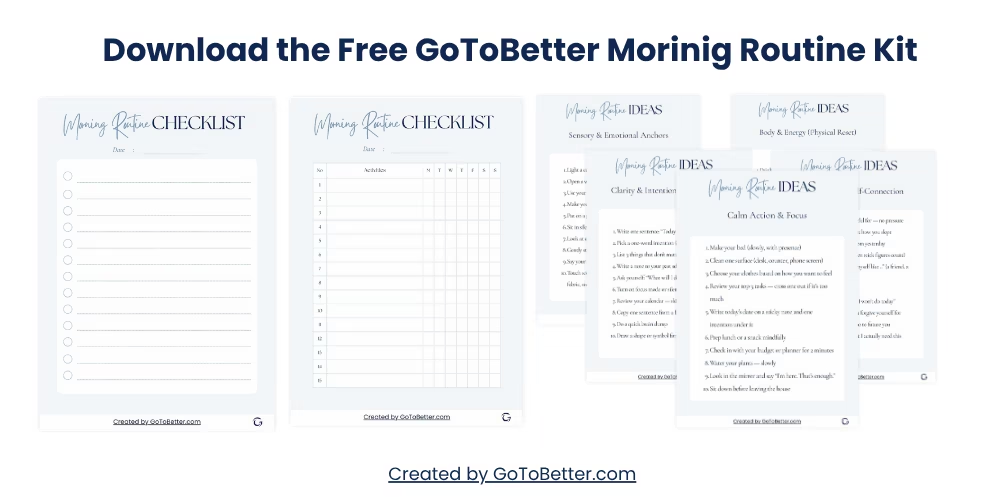
Before you go further, grab your free Morning Routine Kit. It gives you something solid to hold onto while you experiment:
- 50 Morning Routine Ideas — a categorized list of flexible actions for every kind of morning
- Daily Morning Routine Template — a clean space to map or track your mornings day by day
- Weekly Morning Planner — try different versions, see what actually works
No apps. No pressure. Just paper (or PDF) you can circle, sketch, or adjust as you go.
Write your email and get your Free Kit here↓
What It Really Means to Make a Morning Routine
To make a morning routine is to design a short, repeatable sequence that helps you start your day with intention — not to perform a perfect script.
The point isn’t an “ideal” checklist. The point is a simple routine that matches your energy in the morning and your real constraints.
Think of it like a note on your fridge — always in sight, easy to follow, quick to adjust. When life changes, the note changes. The routine isn’t a test of willpower; it’s a small engine that turns on your day.
Popular books talk about morning ritual frameworks (Hal Elrod’s “SAVERS”), habit mechanics (James Clear on cues and friction), and circadian rhythm basics (Andrew Huberman on light and movement). Useful, if filtered through your context. The filter matters more than the formula.
So here’s the working definition: a morning routine is a personal, low-friction pattern that reliably gets you from “not quite awake” to “ready for the next thing.” It can be two steps or five. It can flex between weekdays and weekends. It can be done at 5:30 AM or 11:00 AM. The clock is not the boss — your life is.
You might notice the best morning routine often looks boring on paper. That’s a good sign. Boring is repeatable; repeatable becomes powerful. Choose actions you can do in messy kitchens, loud homes, hotel rooms, and quiet mornings alike. That adaptability is what keeps a consistent routine alive.
Design for repeatability.
Why Most Morning Routines Fail (And What Actually Works)
Most routines fail because they ask for too much, too soon. More steps do not mean a more productive morning. In practice, more steps often mean more friction, more decision points, and more ways to fall off.
Another reason: routines are copied, not created. Borrowing ideas is fine; borrowing identities is not. If a plan assumes silence, sunlight, and spare time — but your mornings include kids, commute, or shift work — the plan will buckle. The mismatch isn’t your fault; the design was wrong.
There’s also the “all-or-nothing” trap. One skipped day turns into a skipped week. Consistency becomes perfection, and perfection collapses under real life. Remember: five minutes of calm beats thirty minutes of chaos.
What works instead? Right-size the routine to the day. Treat steps as modular pieces. Keep a short version and a long version. Make props visible (water bottle by the sink, shoes by the door, notebook on the table). Reduce choices when you’re groggy; build variety after you’re awake.
Research lines up: circadian cues like light exposure, hydration, and light movement are reliable anchors for morning habits. They support alertness without demanding heroics. From there, add one focus step that moves your priorities forward, even slightly.
GoToBetter says it like this: “Consistency beats intensity — a two-step morning done daily outruns a perfect routine done rarely.”
Test anything new for seven mornings. Keep what helped. Tweak what snagged. The mark of a durable plan isn’t how impressive it looks; it’s how quietly it keeps working.
Smaller, sooner wins.
How to Build a Morning Flow You’ll Stick To
Start by naming your constraints: wake time, commitments, noise level, and how much energy in the morning you typically have. Then choose a size: “5-minute,” “15-minute,” or “30-minute.” Size first, steps second.
Choose Anchors
Pick one body anchor and one mind anchor. Body anchors: water, light, stretch, short walk. Mind anchors: one line of journaling, 60 seconds of planning, one page of reading. Keep it obvious and close at hand.
Build the Sequence
Combine anchors with one priority step. Priority = a small action that makes the rest of the day easier (packing a snack, laying out clothes, drafting the first sentence of an email). This is where you make a morning routine serve real life, not aesthetics.
GoToBetter InsightStart with a two-anchor pattern: one body cue, one mind cue. Add a single priority step after a week. Layer slowly; stability scales better than ambition.
Keep It Visible
Put your steps where you’ll see them. A tiny card on the nightstand. A sticky note on the kettle. Visibility beats memory at 6 AM.
When you want a quick check against over-engineering, use this table. If it adds friction, adjust or remove it.
| Habit | Track It? | Why |
|---|---|---|
| Drink water | No | Binary and obvious — just place the glass at night. |
| Light exposure | No | Walk to a window or step outside; circadian cue, low effort. |
| 60-sec plan | Optional | A single line sets focus; skip if it becomes a rabbit hole. |
| Stretch 2 minutes | No | Body wakes up gently; no mat needed. |
| One priority step | Optional | Only if feedback helps; otherwise let the outcome speak. |
Use lists of daily routine ideas sparingly. The more you add, the less you’ll do. Two anchors plus one priority is enough for most seasons.
Build small, then polish.
Daily Routine Ideas for Different Lives
Some mornings, it feels like your plans live in a different time zone. That’s normal. A routine that respects your chaos will carry you further than an “optimized” one that argues with reality.
Here are variations that readers report repeating — the kind that actually help you start your day without drama.
If mornings belong to small humans
Before the house wakes: water, window light, one breath with a hand on the chest. After breakfast: put fruit on the counter for later morning habits, set out shoes by the door. The priority step might simply be checking the bag for keys and snacks. It’s not glamorous; it’s reliable.
If shifts move your clock
Anchor on waking, not on sunrise. Curtain-open light or bright lamp, quick mobility, one line that says “What matters next?” Keep the same pattern whether you wake at 6 AM or 2 PM. A simple routine beats chasing the “best morning routine” when your morning occurs at noon.
If you’re studying
Water, one page, one sentence of plan. The page could be a textbook paragraph or a printed note. The sentence sets the first focus block. Keep the phone off the desk for ten minutes. That tiny delay protects attention more than a dozen hacks.
If you work from home
Open blinds, step outside for sixty seconds, coffee or tea, then a two-line “today file.” Add a physical boundary: shoes on, or sit in a particular chair. Small props tell your brain the day has started.
If you’re on the road
Stand by the window, stretch calves, drink water from the bathroom cup, write one line: “One thing that makes today easier is…” That’s your portable morning ritual. Hotel rooms don’t need perfection; they need a script you can run anywhere.
GoToBetter says it like this: “A routine isn’t a place — it’s a pattern. If it fits in a pocket, it fits in your life.”
You might notice that each pattern keeps friction low and identity intact. They’re different on the surface, but under the hood, the formula repeats: body cue, mind cue, tiny priority.
Respect your constraints.
Use the Routine Template to Experiment and Adjust
To keep a consistent routine, version it like software: V1, V2, V3. Run V1 for seven days. Note one friction point and one helpful effect. Change a single element, then run V2 for seven days. Simplicity scales; debugging one variable at a time avoids confusion.
Pacing Options
Hold three sizes in your back pocket: 5, 15, and 30. The 5-minute version is the safety net; the 30-minute version is for surplus mornings. This way you never “break the chain” — you just switch the model. It’s a routine template that adapts itself.
Versioning by Season
Light earlier? Add a short walk. Darker months? Swap to a lamp by the window. Big project? Make the priority step a 60-second draft each morning. New baby? Your win is water-light-breath.
GoToBetter InsightUse a three-size routine library: 5-minute, 15-minute, 30-minute. Switch sizes without guilt. The library preserves momentum when time shrinks.
Short Reflections That Keep You Honest
Once a week, ask: “Which step felt heavy?” “Which step helped most?” “What can be removed?” Keep answers to one line each. The goal is clarity, not journaling as a hobby.
When you make a morning routine flexible on purpose, motivation isn’t the driver. Design is. Design wins on bad sleep, busy weeks, and travel days. That’s how routine becomes identity, not theater.
Edit, don’t overhaul.
How to Make a Morning Routine That Fits Your Life
This step-by-step guide helps you design, test, and adapt a pattern you can run anywhere. Follow the steps in order, and change one thing at a time.
Step 1 – Define Your Constraints
Write your wake time window, non-negotiables, environment noise, and typical morning energy. Constraints are design inputs, not excuses.
Step 2 – Pick Your Size
Choose 5, 15, or 30 minutes for this week. Size limits complexity. It also tells you what to ignore.
Step 3 – Select Two Anchors
Choose one body cue (water, light, stretch) and one mind cue (one line plan, one page reading). Place props where you’ll see them.
Step 4 – Add One Priority Step
Pick the smallest action that moves today forward: prep snack, draft first sentence, set calendar alert. Keep it under two minutes.
Step 5 – Script the First Minute
Write a one-sentence script: “Stand, open blinds, sip water.” First minutes decide if the routine launches.
Step 6 – Make It Visible
Put a tiny card or sticky note where you wake, brew, or sit. Visibility beats memory at low alertness.
Step 7 – Test for Seven Days
Run the exact same pattern for a week. Note one friction point and one helpful effect. No mid-week edits.
Step 8 – Adjust One Thing
Change a single variable (order, duration, prop). Re-run for another week. This is versioning, not starting over.
Step 9 – Keep a 5-Minute Version
When time collapses, run the micro version: body cue, mind cue, one priority. That’s how you stay consistent without pressure.
GoToBetter Mini Tool: The 5–15–30 Morning Switch
One-minute setup. Use this quick flow to lock tomorrow’s routine size and script without overthinking.
- Write your three sizes on a note: 5 / 15 / 30.
- Circle the size you can definitely run tomorrow (pick the smallest that feels honest).
- Choose two anchors for that size: one body cue (water, light, stretch) and one mind cue (one-line plan, one page reading).
- Add one two-minute priority step that makes the day easier (e.g., pack a snack, draft the first sentence of a message).
- Script the first minute in one sentence: “Stand, open blinds, sip water.”
- Place props where you’ll see them (glass on the counter, book on the table, shoes by the door).
- Set a reminder titled “Switch to 5–15–30” for your wake window.
After you run it once, jot two lines: “Helped most:” and “Friction:” Change one thing for the next seven-day test.
Want to Keep Going? Here’s What Helps
You now have a pattern you can run anywhere. Keep it small, keep it visible, keep it honest. That’s how a morning ritual grows without pressure.
This article is one piece of a larger system on real-life mornings. For the full context, pacing strategies, and more daily routine ideas, start here:
Read The Ultimate Guide to Morning Routines — your no-fluff, real-life guide to designing mornings that fit your season.
If you want a simple companion while you experiment, grab the Free Morning Routine Kit. It includes exactly what you need to map, test, and adjust:
- 50 Morning Routine Ideas
- Daily Morning Routine Template
- Weekly Morning Planner
No pressure. Just tools you can circle, sketch, and adapt as you go.
Get the Free Morning Routine Kit:
Make a Morning Routine FAQ
Quick, clear answers to the questions people ask when they’re ready to start but don’t want a rigid script.
How long should a simple morning routine take?
10–15 minutes is plenty for a simple routine that helps you start your day. Begin with a 5-minute version to protect consistency, then expand to 15 or 30 on spacious mornings. Use a three-size “library” so the routine stays consistent even when time shrinks.
Do I need to wake earlier to make a morning routine work?
No. A routine works at whatever time your morning happens. Anchor to waking — not the clock — and use low-friction steps like light exposure and water to boost energy in the morning. Shift workers can run the same simple routine at 11 AM and get the same benefits.
What should I include if I have almost no time?
Use a two-anchor pattern plus one tiny priority. For example: sip water, open blinds, write one line that sets your first task. This micro setup beats chasing the so-called best morning routine when you’re short on minutes.
How do I stay consistent without feeling trapped by rules?
Keep a 5–15–30 size menu and switch sizes instead of “skipping.” Make props visible and script the first minute so groggy brain has no decisions to make. Treat the plan as a routine template you version weekly, not a rulebook.
How do I use daily routine ideas without getting overwhelmed?
Pick two ideas that fit your context today and ignore the rest. Lists are for inspiration, not obligation; the goal is a productive morning, not a perfect checklist. Add one new element only after seven stable days.
Ready to Go Deeper?
When your morning habits start to feel steady, a clear dashboard helps you see patterns and adjust without starting over. That’s where a tracker earns its keep.
Ultimate Habit Tracker (Google Sheets) — fully customizable and device-friendly. Track daily, weekly, and monthly habits, view automated progress, reflect weekly, and keep momentum with visual feedback. One clear view that grows with your goals.
- Save time with automated updates and clean summaries
- Stay private inside your Google account
- Tailor categories, goals, and layouts to your life
Wellness Tracker — a simple daily hub for mood, sleep, and wellness habits. Designed to support habit formation and health awareness without extra complexity.
Self-Care Habit Tracker — keep up to 30 self-care actions visible with gentle check-ins and progress cues. Customize categories and build a kinder rhythm.
Explore all trackers in the shop — tools built for real life, from quick check-ins to deeper reflection systems. Built for real life, not perfection.