

+Free Habit Mastery Kit – Self-Assessment & Visual Guides
Whether you’re curious why habits feel automatic or frustrated by shallow tips, this guide reveals the hidden psychology behind forming habits. Includes: reinforcement science, memory principles, and what most advice gets wrong.
By GoToBetter | Tested by real life, not just theory
Why Habits Feel Automatic: The Psychology You Never Hear About
Most guides say habits are just about grit.
Set a goal, repeat, succeed.
But psychology shows it’s never that simple.
Repetition doesn’t just build skill—it rewires memory.
Rewards don’t just feel good—they anchor behavior.
And punishment?
It often backfires in ways no one warns you about.
This isn’t another list of quick hacks.
It’s a clear look at the hidden forces shaping what you repeat—without you noticing.
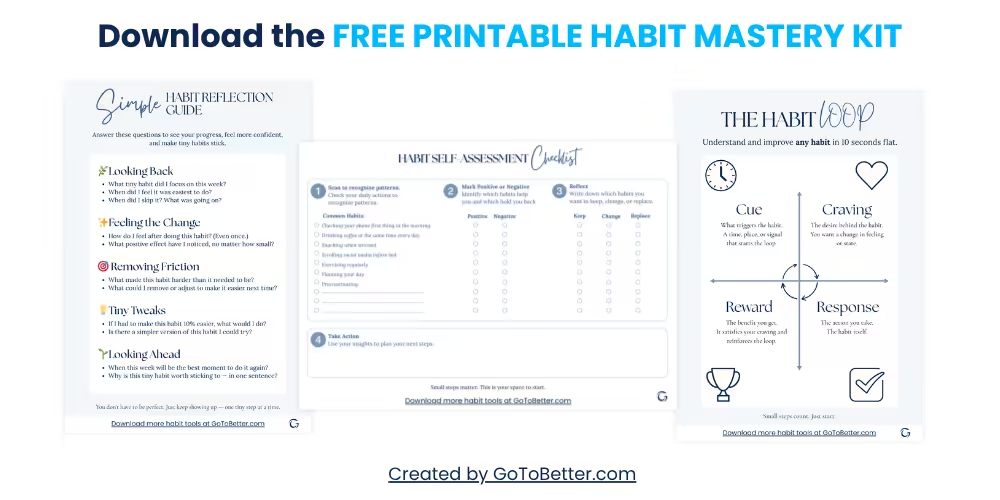
Before you go further, grab your Free Habit Mastery Kit.
It’s designed to help you see these patterns in your own life—without pressure or overwhelm.
Inside, you’ll find:
- A self-assessment checklist to spot hidden habits
- A visual Habit Loop explainer
- A reflection guide to track your patterns over time
No apps. No forced plans.
Just clarity.
Write your email and get your Free Kit here↓
What Is Habit Formation Psychology?
At its core, forming habits psychology studies how behaviors become automatic through a mix of repetition, reinforcement, and memory consolidation.
It’s not simply about wanting something badly enough.
It’s about how the brain rewards efficiency over novelty.
You might notice that certain actions — locking the door, reaching for your phone, pouring coffee — happen without conscious thought.
That’s the outcome of neural pathways strengthened over time.
Researchers like Wendy Wood have shown that up to 43% of daily behavior is habitual, driven by contextual cues rather than active decisions.
This is why some habits feel inevitable.
The mind prefers to economize effort, and once a shortcut exists, it’s difficult to ignore.
One way to picture this is imagining a path across snow.
Each pass compresses the trail a little deeper.
Eventually, stepping off that route feels unnatural.
GoToBetter says it like this: “A habit is your brain rewarding efficiency, not virtue.”
Forming habits psychology doesn’t only ask whether a behavior repeats.
It asks: what reinforces it?
What triggers it?
And why does it feel easier over time?
Understanding this framing helps you see that repetition alone isn’t the only ingredient — reinforcement schedules, memory processes, and environmental consistency all play their part.
Repetition and Memory Consolidation: Making Behavior Stick
Most guides treat repetition like a checkbox: do it enough times, and it sticks.
But psychology shows repetition matters because it helps consolidate memory.
This process — sometimes called long-term potentiation — strengthens synaptic connections so a behavior moves from deliberate to automatic.
Some mornings, you might notice your hand opening a cupboard before you’ve decided what you want.
That’s not mindlessness — it’s your procedural memory taking the lead.
Research published in the journal Neuron highlights how repeating the same action in the same context accelerates this consolidation.
This is why “habit repetition psychology” emphasizes consistent context alongside frequency.
| Process | What Happens | Why It Matters |
|---|---|---|
| Repetition | Activates the same neural pathway repeatedly | Strengthens connections, reducing effort over time |
| Memory Consolidation | Stores behavior in procedural memory | Behavior becomes automatic, triggered by cues |
| Context Consistency | Links environment to the behavior | Makes cues more reliable triggers |
Some evenings, you may wonder why certain behaviors feel entrenched.
The answer often lies in memory.
Every repetition reinforces the trail, making the action feel inevitable.
GoToBetter InsightStart with stable contexts when repeating a behavior. Repetition without consistency weakens the link between cues and memory consolidation.
Reflection can help you see these patterns more clearly:
What actions do you repeat in the same place or time?
Which ones feel automatic regardless of mood?
These are signs memory has done its quiet work.
Reinforcement: The Power of Rewards Over Willpower
While motivation feels compelling, forming habits psychology shows reinforcement is the real driver.
Rewards — even small ones — act as signals to the brain: “Do this again.”
You might notice that pouring a cup of tea after finishing a task feels satisfying in a way the task itself doesn’t.
That closing ritual becomes a reinforcing loop.
B.F. Skinner’s operant conditioning research demonstrated that reinforcement schedules — how and when rewards arrive — dramatically impact how fast habits form.
For example, variable rewards (like occasional praise or surprise treats) tend to lock behaviors in faster because they create anticipation.
It’s easy to think rewards are shallow.
But in psychological terms, they’re simply data points the brain uses to predict value.
Over time, these predictions form the backbone of your habits.
GoToBetter says it like this: “Motivation is the spark. Reinforcement is the fuel.”
Some mornings, you might notice yourself craving a behavior long before the reward arrives.
That’s because anticipation — driven by dopamine — is itself reinforcing.
One common myth is that rewards always weaken intrinsic motivation.
While that can be true in creative work, repeated small rewards often strengthen procedural habits without reducing enjoyment.
When you understand reinforcement as prediction rather than bribery, the process feels less manipulative and more like working with your biology.
Punishment and Its Limits: Why Deterrents Often Backfire
Some theories suggest that punishing a behavior stops it.
But forming habits psychology shows deterrents rarely erase a pattern.
They often just push it underground or create avoidance.
Imagine a parent scolding a child for snacking.
The behavior may pause in front of others but reappear when no one is watching.
This dynamic — punishment suppressing behavior only temporarily — is well documented.
Researchers have found that punishment creates emotional associations that can paradoxically strengthen the habit loop.
Stress and guilt can become cues themselves.
Consider how many people “stress snack” or “doom scroll” after a difficult conversation.
The initial punishment becomes another reason to repeat the cycle.
GoToBetter InsightUse awareness instead of punishment when examining habits. Deterrents often entrench behaviors by adding emotional cues to the loop.
This doesn’t mean all consequences are useless.
But if you expect punishment to erase a habit, you may be disappointed.
Psychological habit loops often adapt faster than your willpower.
Reflection question:
When you’ve tried to stop a habit with criticism or guilt, what happened over time?
Did it fade — or go underground?
Automaticity and the Brain’s Efficiency Principle
Automaticity is what makes habits feel like they happen to you rather than by you.
It’s your mind preferring efficient, low-energy paths over fresh decisions.
Procedural memory — stored in structures like the basal ganglia — allows you to perform repeated actions without attention.
That’s why you can lock your door while planning dinner in your head.
This is one reason habits feel so resistant to change.
Once the brain recognizes a familiar cue, it activates the whole sequence before you’re aware.
You might notice this when driving the same route home and realizing you don’t remember the last few blocks.
Or when reaching for your phone before deciding why.
Psychology of forming habits shows that these automatic patterns aren’t signs of weakness — they’re signs of a brain working efficiently.
GoToBetter says it like this: “Repetition doesn’t just make actions easier — it makes them inevitable.”
Metaphorically, think of your brain as a river carving a canyon.
The longer the water flows the same way, the deeper the groove.
Changing course isn’t impossible — but it requires redirecting that current, not just wishing it away.
Motivation vs. Reinforcement: Why Good Intentions Fade
Many people assume motivation is the main engine of habit.
If you care enough, you’ll persist.
But forming habits psychology consistently shows that motivation is volatile, while reinforcement is stable.
You might start a new behavior feeling energized.
The first week of running feels fresh.
But as novelty wears off, motivation drops.
If reinforcement — in the form of a reward or a sense of progress — isn’t present, the habit dissolves.
Researchers like B.J. Fogg describe this as the “motivation wave.”
At its peak, you can do hard things.
But as it recedes, only low-friction, consistently reinforced actions survive.
Consider this reflection:
Which habits have you started with enthusiasm but abandoned once daily life got busy?
Which ones continued because they felt rewarding in themselves?
In this way, reinforcement theory habits are more resilient because they don’t depend on how you feel in the moment.
They rely on your brain’s prediction that repeating the action is worth it.
For example, someone who studies in the same chair at the same time each day eventually feels an almost magnetic pull to sit down.
The environment, timing, and accumulated rewards create a psychological habit loop stronger than any burst of motivation.
This isn’t to say motivation is unimportant.
It often initiates behavior.
But reinforcement consolidates it into memory.
Over time, that’s what builds automaticity.
Why Habits Resist Change Even When You Try
Some mornings, you might resolve to break a habit.
You feel determined, certain this time will be different.
But forming habits psychology shows why determination alone rarely overrides a strong pattern.
Once procedural memory encodes a sequence, it activates faster than conscious thought.
This is why even months after stopping, a familiar cue can reactivate an old habit.
Consider a person who moves back to their childhood home and finds themselves falling into routines they thought were long gone.
This isn’t regression.
It’s the efficiency principle in action.
Ann Graybiel’s research on the basal ganglia illustrates this process.
Neural pathways don’t disappear.
They go dormant, ready to re-engage when context aligns.
This helps explain why habits are so persistent.
They represent a brain optimized for conservation.
If a shortcut exists, your mind will prefer it.
Reflection can help here, too:
What cues reawaken behaviors you thought you’d outgrown?
Where do you feel pulled into old loops without realizing?
Understanding that habits are memory in motion can reduce self-blame.
It isn’t about lacking discipline.
It’s about biology doing its job.
How to Map Your Reinforcement Patterns Step by Step
This guide will help you see your reinforcement cycles clearly, without suggesting changes — just observation.
Step 1 – Pick One Behavior
Choose a habit you do often, like checking your phone or snacking after work.
Step 2 – Identify the Cue
Write down what typically triggers the action — time, place, emotion, or preceding event.
Step 3 – Note the Reward
Describe what feels good or relieving after the behavior, even if it’s subtle.
Step 4 – Track Repetition
For a week, tally how often this cycle repeats and in what contexts.
Step 5 – Reflect on Patterns
Look for trends: when does the behavior feel most automatic? When does it fade?
Final Thoughts: Seeing Habits Without Blame
When you start to see habits as neural pathways rather than personal failings, the process feels different.
Repetition, reinforcement, and memory aren’t enemies.
They’re the way your brain keeps life manageable.
Some evenings, you’ll notice an old pattern slip back in.
That doesn’t mean you’ve failed.
It means the groove still exists, ready when conditions align.
Forming habits psychology helps us trade frustration for understanding.
Instead of wondering why motivation disappears, you can look for the hidden reinforcers making a behavior feel worthwhile.
One study in Psychological Review found that habits often serve to reduce uncertainty, offering predictability in a changing world.
Even unhelpful habits can meet this need.
When you notice a pattern, ask:
What is this helping me feel or avoid?
What reinforcement keeps it alive?
From there, awareness grows.
Not to force change, but to see clearly.
Because when you see the forces behind what you repeat, you reclaim the option to respond differently — one small moment at a time.
GoToBetter Mini Tool: Map Your Habit Reinforcers
This quick exercise helps you see what rewards and reinforcers make your habits feel automatic. You can do it in 2–3 minutes with a pen or just think through each step.
- Pick one habit you often do without thinking. Write it down or hold it in your mind.
- Identify the cue: What happens right before you start? A time, place, feeling, or signal?
- Describe the reward: What feels satisfying, relieving, or comforting after you do it?
- Consider this question: If the reward disappeared, would you still feel pulled to repeat it?
- Write one sentence capturing why this behavior feels worth repeating.
Want to Keep Going? Here’s What Helps
This support article is part of the GoToBetter Habit Series — a clear, research-backed look at how habits form beneath the surface.
If you’re curious about the bigger picture behind daily patterns, start here:
Read The Ultimate Guide to What Are Habits — your no-fluff introduction to how automatic behaviors shape nearly half your day.
Or if you want something simple to get started right now, you can grab the Free Habit Mastery Kit — no apps or sign-ups required:
- A printable self-assessment checklist
- A Habit Loop explainer with visuals
- A reflection guide to track your patterns
Curious to see what drives your habits? Enter your email to download the kit and start exploring with clarity.
Forming Habits Psychology FAQ
How does reinforcement create a habit?
Reinforcement creates a habit by rewarding behavior so the brain predicts value in repeating it. Over time, the action feels worth doing even without conscious planning. For example, a small pleasure after exercising makes the routine more likely to recur.
Can punishment remove a bad habit completely?
Punishment rarely erases a habit fully. It can suppress the behavior in the moment, but the underlying cue–reward loop often stays intact. Many people find the habit re-emerges in private or under stress, especially if the punishment also adds emotional tension.
Why do habits feel easier over time?
Habits feel easier because repetition builds neural pathways that reduce effort. This process is called procedural memory consolidation. When pathways strengthen, the action requires less conscious thought, making it feel automatic and frictionless.
What’s the difference between motivation and reinforcement?
Motivation is the initial desire to act, while reinforcement is what sustains repetition. Motivation can fade quickly after starting a behavior. Reinforcement — through consistent rewards — helps habits persist even when motivation dips.
Ready to Go Deeper?
When your daily habits start to feel predictable, you might want a clearer way to track what’s working and what’s not.
The GoToBetter Shop has printable trackers and guided journals designed to help you see your patterns in one calm place.
Explore the collection here:
Visit the GoToBetter Shop — from quick daily check-ins to full reflection systems, there’s something to fit your flow.