
+Free Habit Builder Starter Kit (Printable Templates Included)
How to build habits that stick, using a process that works beyond motivation. This guide shows you exactly how to design, practice, and strengthen habits that stay with you for good.
By GoToBetter | Tested by real life, not just theory
Why Building Habits Feels Harder Than It Should
Let’s be clear—learning how to build habits isn’t complicated because you’re lazy or undisciplined. It’s complicated because most advice skips the part where real life happens.
You set a goal, pick a habit, and expect it to work if you just care enough. But caring isn’t the problem. What breaks habits is the gap between intention and practice—especially when days get messy.
This guide won’t promise instant transformation. It will show you how to build habits that last longer than your initial motivation—using methods that work when things aren’t perfect.
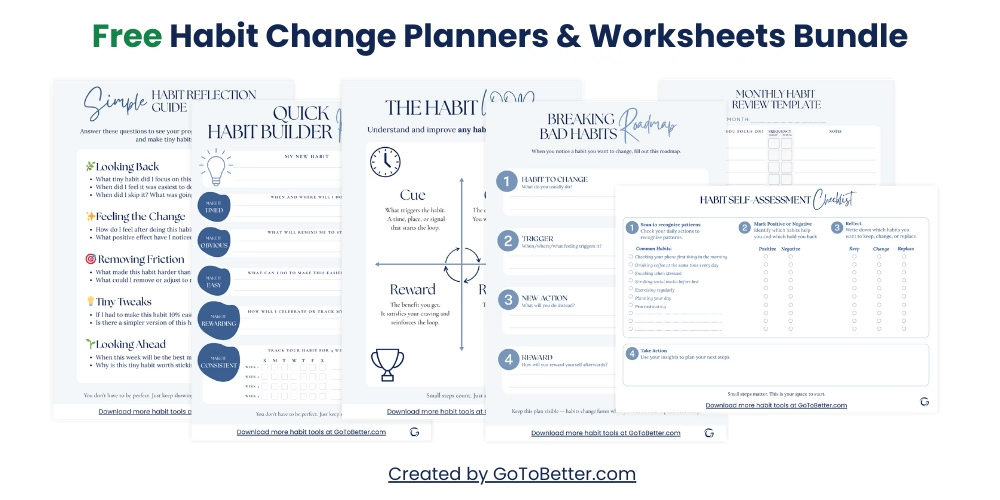
Before you dive in, download your free Habit Builder Starter Kit. It’s a set of printable tools to help you design, track, and review your habits without apps, spreadsheets, or endless tweaking.
If you’ve ever wondered how to build habits that actually stick, you’ll find the answers here—clear, step-by-step, and rooted in what works in daily life.
Inside, you’ll find:
- Simple Habit Reflection Guide – Questions to help you see what’s working, what needs adjusting, and why your effort matters.
- Quick Habit Builder Planner – A clear template to map out your habit, remove friction, and start tracking your first week.
- Monthly Habit Review Template – A one-page format to measure progress and reset your focus each month.
These tools won’t do the work for you. But they will keep you honest, organized, and focused—so you can build habits that actually fit your life.
Write your email and get your Free Habit Builder Starter Kit here ↓
Why Habits Fail (Even When You Really Want Them To Work)
If you’ve ever wondered how to build habits and still ended up dropping them, you’re not alone. Most people don’t fail because they’re lazy—they fail because their system isn’t built for real life.
Understanding where things go wrong is part of learning how to build habits that actually last. Here are four common reasons habits fall apart—and how to fix them.
Failure #1: Starting too many habits at once
Even good habits compete for your time and attention. If you try to change five things at once, you’ve just added five new decision points to your day.
It’s one of the fastest ways to burn out. When you’re figuring out how to build habits that stick, the smartest move is to start with just one that really matters to you—and let it settle before adding more.
Failure #2: Aiming too big, too soon
It’s easy to get excited and set big goals. But that excitement fades fast. What starts as a 30-minute routine can feel impossible after three bad nights of sleep.
If you want to build sustainable habits, the real move is to go small—so small that you can keep going even when life is messy. That’s how habits grow: through low-friction repetition, not grand ambition.
Failure #3: Relying on willpower, not your environment
We often think that learning how to build habits is about discipline—but in reality, your space has more influence than your willpower. A cluttered room, a noisy phone, or a missing tool can quietly sabotage your best intentions.
When you adjust your environment to support your habit—like prepping the night before or making the next step obvious—you make success easier by default.
Failure #4: Treating every lapse like failure
One skipped day doesn’t ruin anything. But if you believe it does, you might quit entirely. That’s one of the most common traps people fall into when trying to build habits that last.
The real skill isn’t perfection—it’s return. The quicker and more gently you come back, the stronger your habit becomes over time. That’s how to build habits that can survive setbacks without falling apart.
GoToBetter says it like this: “Most habits don’t fail. People just stop after one imperfect day.”
For a deeper breakdown of the most common mistakes, see 7 Habit-Building Mistakes to Avoid.
Common Myths That Quietly Sabotage Habit Building
Even when you’ve learned how to build habits step by step, some outdated beliefs can still sneak in and quietly work against you. These myths often sound like helpful advice—but they set up expectations that collapse under real-life pressure.
Before you move forward, let’s clear out the most common misconceptions. They’re not just annoying—they directly block your ability to build sustainable habits that last longer than a burst of motivation.
Myth 1: You Have to Do It Every Day
One of the most persistent myths about how to build habits is the idea that it only works if you never miss a day. The all-or-nothing mindset sounds disciplined—but it creates fragile systems.
Real habits don’t require perfect streaks. They require return. If you miss three days and restart on day four, the habit isn’t broken. It’s alive. It’s growing. That’s how sustainable habits actually form—through imperfect repetition, not rigid performance.
GoToBetter says it like this: “The habit isn’t broken. It’s just waiting for you to pick it up again.”
Myth 2: Motivation Will Carry You
Many people think that learning how to build habits means learning how to stay motivated. But motivation is unreliable. It depends on your mood, your sleep, your stress level, your hormones—none of which stay constant.
That’s why the real key isn’t motivation. It’s structure. The way you design your habit—tiny, friction-free, environment-supported—is what determines whether it survives the hard days.
If you want to build habits that stick, don’t wait to feel inspired. Build systems that work even when you don’t.
Myth 3: You Have to Track Everything
Tracking can be helpful—but it’s not required. In fact, many people give up on habit change entirely because they feel like they’re “failing” the moment they forget to check a box.
If you like visual reminders, use them. But if tracking creates pressure or perfectionism, skip it. One of the most underrated truths about how to build sustainable habits is this: repetition is what wires change—not charts.
For minimalist tracking ideas, you can explore more in The Ultimate Guide to Habit Tracking.
Myth 4: You Have to Feel Ready Before You Start
Waiting to feel ready is one of the most deceptive barriers to starting. But the truth is: readiness usually follows action—not the other way around.
When you study how to build habits that last, you’ll notice a theme: most successful routines begin before people feel fully confident. They start because the first step is small, safe, and realistic—even when energy is low.
That’s how momentum builds. You don’t need to believe in yourself yet. You just need to begin.
Myth 5: The More Complex the Habit, the Better
Complicated systems might look impressive, but they often fall apart in daily life. Color-coded trackers, perfect routines, five-step rituals—all great until you’re tired, sick, or overwhelmed.
Learning how to build habits that stick means choosing simplicity over aesthetic complexity. The best habits survive not because they’re clever, but because they’re easy to repeat—even on bad days.
If your system needs 20 minutes to manage and only 2 minutes to do, it’s working against you. Start smaller. Stay consistent. Let it grow when you’re ready.
1. How to Choose a Habit That Sticks
Most people skip this step because it sounds too simple.
They jump into generic goals like “exercise more” or “be productive” without asking why they chose them in the first place.
The problem? A habit that doesn’t feel connected to something you value will rarely survive a hard day.
The first step in understanding how to build habits that stick is choosing a habit that actually matters to you right now—not to your past self, your friends, or a book you read last year.
When you’re thinking about how to build habits you can keep showing up for, it helps to start small and stay honest about what you really care about.
You might notice there are several areas calling for attention.
Maybe it’s health. Maybe it’s focus. Or simply feeling a little more stable every morning.
Instead of picking everything, start with one.
Just one area you genuinely care about improving.
This is the foundation of how to build habits that last past the first wave of excitement.
Some mornings, it feels like any habit would help. But a scattered focus will only water down your effort.
A single clear target is the most sustainable place to begin.
GoToBetter says it like this: “A habit that feels urgent but isn’t important will disappear the moment life gets noisy.”
One simple way to find your priority is to ask yourself what kind of day you want more of.
Not the ideal, polished version—just a day that feels closer to where you’d like to be.
When you think about that, what one action would make the most difference?
That’s your starting point.
If you want more help turning that choice into a realistic first step, read How to Start New Habits.
GoToBetter Mini Tool: Prioritize One Habit
Take five minutes to narrow your focus. Use this quick check:
- Write down the three areas of life where you most want change.
- Under each, list one habit you believe would help.
- Circle the habit that feels both realistic and meaningful.
- Set aside the rest for now—this is your priority.
Choosing one focus doesn’t mean you’re ignoring everything else.
It means you’re giving yourself the best chance to succeed without spreading your attention too thin.
2. How to Start a Habit in Real Life
This step is where most well-intentioned plans collapse.
You pick a meaningful habit, feel a surge of energy, and set the bar too high.
One week later, that surge is gone—and so is the habit.
If you want to know how to build habits that stick, this is the moment to scale your ambition down.
When you start smaller than feels necessary, you give yourself something more reliable than motivation: momentum.
A small beginning doesn’t insult your potential—it protects it.
For example, if you’re trying to build a reading habit, you might feel tempted to commit to thirty pages a day.
Instead, make your initial target one paragraph.
If you do more, great—but the baseline is so small you can meet it even on bad days.
Starting small doesn’t mean starting insignificant.
A tiny habit repeated consistently has more impact than a big habit repeated sporadically.
If you want to see how tiny actions create real momentum over time, read Small Habits, Big Change.
GoToBetter says it like this: “Momentum grows from the smallest repeatable action—not the biggest burst of ambition.”
You might feel uneasy when you lower the bar.
It can feel like you’re not taking yourself seriously.
But often, the simplest way to build sustainable habits is to make the first step almost laughably easy.
If you feel like you can only manage a minimal version, remember: this is the doorway to consistent action, not the final stage.
For a full breakdown of how small actions can still lead to big change, see The Ultimate Guide to Micro Habits.
Over time, you can expand.
But in the beginning, your goal is to build the reflex of showing up, not the record of perfect performance.
GoToBetter Mini Tool: Shrink Your Start
Define the smallest version of your new habit:
- Write your chosen habit.
- Reduce it by 80% (e.g., from 20 minutes to 4).
- Make that the minimum action required to count as success.
Anything extra is optional bonus, not expectation.
Consistency becomes easier when you don’t have to negotiate with yourself every day about whether you’re doing enough.
A small habit is easier to repeat, which makes it more likely to last and evolve into something bigger.
3. How to Make Your Habit Visible and Easy
It’s easy to believe that willpower alone will carry you through.
But most sustainable habits are less about inner resolve and more about external design.
Your environment is always shaping your behavior—even when you’re not aware of it.
A phone on the table pulls your attention.
A cluttered countertop makes cooking feel like work before you begin.
If you want to build habits that stick, you need to make the desired action frictionless and the alternatives less convenient.
GoToBetter InsightSet out what you need before you need it. One method is preparing your environment the night before, so your morning self doesn’t have to think.
Here are a few examples of simple environmental tweaks:
- Lay out your workout clothes the night before.
- Set your book on your pillow so you see it before bed.
- Pre-fill your water bottle and leave it on your desk.
These changes aren’t about discipline—they’re about making the default behavior the one you want.
That’s why it works even on days you feel distracted or tired.
Sometimes, combining environmental design with habit stacking can make new behaviors almost automatic.
If you’re curious about how stacking works, you can explore the dedicated guide to Habit Stacking.
Small environmental changes rarely feel transformative in the moment.
But over time, they remove the hidden friction that silently kills most good intentions.
Consider this: if you have to decide whether to take action every day, your habit is already competing for energy.
When the environment cues you automatically, the decision shrinks—or disappears entirely.
| Habit | Environmental Cue | Why It Helps |
|---|---|---|
| Daily reading | Book on pillow | Creates a visible reminder at the right time |
| Morning exercise | Clothes laid out | Reduces preparation friction |
| Hydration | Water bottle in sight | Makes action obvious and accessible |
Even small adjustments can change the odds in your favor.
When your environment supports your intention, you spend less energy fighting your defaults—and more building the habit itself.
GoToBetter Mini Tool: Environment Check
Spend ten minutes walking through your space and spotting friction points:
- Choose one habit you want to support.
- Look around the area where you usually perform it.
- Remove one obstacle and add one cue that makes the habit easier to start.
- Commit to testing this change for seven days.
4. How to Keep Showing Up Without Motivation
One of the most damaging myths about how to build habits is the idea that success means never missing a day.
In real life, you will miss days.
Work will get busy. You’ll get sick. Motivation will flicker.
The goal isn’t a perfect streak. The goal is the ability to return after you slip.
Habit strength comes from repetition, but also from how quickly you come back after a pause.
GoToBetter says it like this: “The most important day in any habit isn’t the first day. It’s the day you start again.”
Consider this scenario.
You build a meditation habit for 14 days straight, then stop for a week.
The old mindset says you’ve failed.
But if you pick it up again on day 22, you’re proving to yourself that the habit is bigger than a single streak.
That mindset shift is the foundation of lasting change.
When you expect that you’ll need to restart, you remove shame from the equation.
And shame is the fastest way to make a lapse permanent.
There’s more about this topic in Overcoming Habit Friction and Top Habit Building Mistakes, but here you only need one principle: return is success.
Next time you skip a day, treat it as data—not evidence that you can’t change.
GoToBetter Mini Tool: Create a Return Plan
Write this simple sentence somewhere visible:
“When I miss a day, I will restart by doing the smallest version of my habit within 48 hours.”
This rule helps you avoid letting a short gap become a permanent stop.
5. How to Build Habits That Survive Real Life
At some point, you’ll feel that your small habit has become part of your day.
It no longer requires negotiation or reminders.
That’s when you can expand—if you want to.
Growth happens when you add more repetitions, increase duration, or layer a related habit.
But more is not automatically better.
When you’re exploring how to build habits that truly last, remember that simplicity often works longer than complexity.
The trap is assuming you must keep adding complexity to feel progress.
Sometimes, keeping your habit small and stable is exactly what you need.
Other times, you’ll feel ready to grow—and that’s part of learning how to build habits that can evolve as your life changes.
How do you know the difference?
If maintaining the habit feels effortless and you feel curious about doing more—not pressured—that’s a good sign you’re ready to expand.
GoToBetter says it like this: “Growth is sustainable when it feels like an invitation, not an obligation.”
Consider these options for expanding:
- Adding five more minutes to your practice.
- Doing the habit twice a day instead of once.
- Pairing it with a related habit (like reading after journaling).
If you’re unsure, try expanding for one week, then reassess.
You can always scale back if it feels forced.
For more on keeping momentum, see Building Consistency.
GoToBetter Mini Tool: Expansion Check
Ask yourself these three questions before growing your habit:
- Does this feel like something I want, not something I should?
- Can I maintain this expanded version for at least 14 days?
- If life gets busy, can I safely shrink back to the smaller version?
If you answer “yes” to all three, you’re ready to try expanding.
Next Steps?
Building habits isn’t a race to a finish line.
It’s a process of steady strengthening.
Some days, you’ll feel like you’re making obvious progress.
Other days, you’ll wonder if it’s working at all.
That’s normal.
Real change rarely happens in obvious ways.
Most of it happens quietly—through repetition, small returns, and ordinary moments that build momentum you barely notice.
GoToBetter says it like this: “Success isn’t measured by how big your first step is. It’s measured by how many times you’re willing to step again.”
If you’d like extra tools to make your process easier, the GoToBetter Habit Builder Starter Kit is ready for you.
It includes clear, printable resources you can use immediately—no apps or subscriptions.
Here’s what you’ll find inside:
- Simple Habit Planning Sheet: One page to define your habit, environment tweaks, and success criteria.
- Weekly Reflection Template: Space to track progress and plan gentle adjustments.
- Quick Start Checklist: A 5-step prompt to help you start without overthinking.
Whether you’re starting fresh or rebuilding after setbacks, these tools give you a structured, no-pressure way to stay consistent.
And if you need to step back and assess what’s helping or blocking your progress, use the Habit Audit Worksheet.
Write your email and get your Free Kit here ↓
No hype. No guilt. Just small actions repeated until they feel like part of who you are.
Frequently Asked Questions About Building Habits
How long does it take to build a new habit?
The timeline varies widely depending on the habit, context, and your consistency. While you’ll often hear numbers like 21 or 66 days, the research shows the real range is anywhere from 18 to 254 days (Lally et al., European Journal of Social Psychology). The most reliable predictor isn’t the calendar—it’s how often you repeat the behavior in the same context.
What if I miss a few days in a row?
Missing days is normal. The key is how quickly you return. Treat the lapse as data, not failure. Recommit by doing the smallest version of your habit as soon as possible. Remember: consistency over time matters more than any single gap.
Do I need to track my habits?
Tracking can help some people stay aware and motivated, but it’s not required. If you feel stressed by charts and checkboxes, skip them. Focus on repeating your action in the same context until it becomes automatic. If you prefer visual reminders, try a simple paper checklist.
How do I choose which habit to start with?
Start with a habit that feels meaningful and doable. One way is to ask yourself: “What one action would make my day feel 5% better or easier?” Begin there. If you’re unsure, pick a small version of something you already value—like reading one paragraph, stretching for one minute, or drinking a glass of water.
How do I know when to expand my habit?
When your habit feels automatic and you feel curious about doing more—not pressured—it’s usually safe to grow. Expansion should feel like an invitation, not an obligation. If you’re uncertain, test a small increase for a week and see how it feels before committing longer term.
Quick Summary: How to Build Habits That Stick
To sum it up clearly—here are the core ideas from this guide, stripped of fluff and hype. These are the real moves that help habits survive actual life:
- Start with one meaningful habit that improves your real life
- Shrink the habit to the smallest version that still counts
- Design your environment to remove friction and prompt action
- Expect to restart—streaks don’t matter, return does
- Only expand once the habit feels automatic and light
If you want a simpler action-focused version of this process, use the Habit Building Checklist.
If you’re ready to stop guessing and start building habits that actually last, the Free Habit Change Planner Bundle gives you a clear, printable way to make it happen—step by step, without pressure, and without apps.